CART go to cart
Books
Total
FREE SHIPPING COSTS
FOR ORDERS OVER
35 € TO ITALY
70 € TO EUROPElimits and conditions

Liberty before Liberalism.

Author:
Publisher: Cambridge University Press.
Date of publ.:
Details: cm.13,5x21,5, pp.XIV,142, brossura con copertina figurata.

Abstract: This extended essay by one of the world's leading historians seeks, in its first part, to excavate and to vindicate, the neo-Roman theory of free citizens and free states as it developed in early modern Britain. This analysis leads on to a powerful defence of the nature, purposes and goals of intellectual history and the history of ideas. As Quentin Skinner says, 'the intellectual historian can help us to appreciate how far the values embodied in our present way of life, and our present ways of thinking about those values, reflect a series of choices made at different times between different possible worlds'. This essay provides one of the most substantial statements yet made about the importance, relevance and potential excitement of this form of historical enquiry.

EAN: 9781107689534
ConditionsUsato, come nuovo
EUR 13.00
Last copy
Add to Cart

See also...

#291562 Filosofia
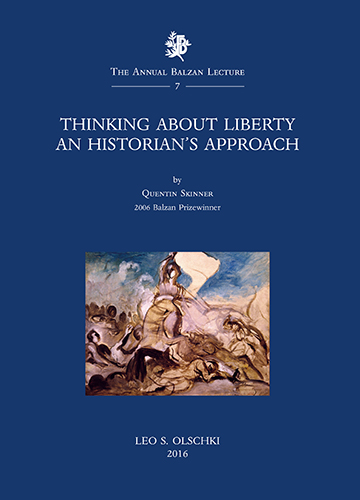
2006 Balzan Prizewinner. Firenze, Olschki Ed. 2016, cm 17 x 24, 78 pp. con 4 tavv. f.t. a colori, brossura The Annual Balzan Lecture,7. Testo in Inglese. Contemporary political theorists frequently say that there is only one coherent way of thinking about liberty, and that it consists in recognising that an individual is free so long as there is no interference with the exercise of his or her powers. In Thinking About Liberty: An Historian’s Approach, Quentin Skinner shows that this is mere dogma by tracing a genealogy that considers different ways of thinking about liberty, a central concept in social and political thought in today’s Western democracies. He isolates three distinct strands in the genealogy of modern liberty, including the above mentioned freedom as absence of interference (by external agencies or by the self), as well as two alternatives: freedom as absence of dependence (as in liber homo vs slave status) and freedom as self-realisation. In speaking as an historian, Skinner’s chief concern is to excavate a way of thinking about freedom that has lately been in danger of getting lost. The lecture also presents Skinner’s 2006 Balzan Prize research project, which involved young European scholars to address questions about the place of civil, religious and political liberty in the formation of modern Europe.

EAN: 9788822264602
Nuovo
EUR 21.00
-10%
EUR 18.90
Orderable

Recently viewed...

Traduz.di Gabriella de' Grandi. Palermo, Sellerio Editore 1987, cm.12x16,5, pp.273, firma a penna in antip.e leggere tracce d'uso. brossura sopraccop.ill.a col. Coll.La Memoria,109. Terza edizione.
Usato, molto buono
EUR 7.00
Last copy
#294434 Filosofia
A cura di Andrea Casalegno. In appendice le illustrazioni di Eugene Delacroix per il Faust. Milano, SE Ediz. 2013, cm.13x22, pp.135, 20 tavole bn.ft. brossura con bandelle, cop.fig.a col. Coll.Aestetica,8. Scritti da György Lukács (1885-1971) nel 1940, nel momento più oscuro della nostra storia, questi «Studi sul “Faust”», e gli altri saggi sull’età goethiana poi raccolti in «Goethe e il suo tempo» (1947), gli consentono di contrapporre alla barbarie del nazismo la voce più umana, più illuminata, più europea in cui si sia mai incarnato il magistero della lingua tedesca. Ma è sul «Faust» che Lukács eccelle, consegnandoci sui problemi fondamentali di questa «Iliade della vita moderna», come fu definito da Puškin, un’interpretazione profonda e tuttora valida. Sul significato della vicenda e sull’interpretazione della storia umana che la sottende, sulla scommessa tra Faust e Mefistofele e sul suo discusso epilogo, sull’amore tra Faust e Margherita, sui «problemi di stile» – sul rapporto tra caratteri «epici» e caratteri «drammatici» della tragedia, sulla «laconicità» del tardo Goethe, sul fatto fondamentale che in lui «il fantastico ha le sue radici proprio nel realismo» – Lukács ha scritto pagine esemplari e definitive. Nel caso del «Faust» l’applicazione intelligente delle categorie interpretative ricavate dalle opere giovanili di Marx, lungi dall’essere una gabbia ideologica che irrigidisce l’interpretazione, si trasforma in una leva potente, che permette a Lukács di mettere in luce un elemento fondamentale della visione di Goethe, sfuggito a ogni altro critico: la perfetta convergenza della «magia» di Mefistofele con il «magico» potere del denaro che, nella nascente società del capitalismo industriale, si appropria delle forze essenziali dell’uomo e le sfrutta a proprio vantaggio. (Andrea Casalegno)

EAN: 9788884169938
Nuovo
EUR 21.00
-35%
EUR 13.50
Available