CART go to cart ▶
Books
Total
FREE SHIPPING COSTS
FOR ORDERS OVER
35 € TO ITALY
80 € TO EUROPElimits and conditions
▶

Aiol. A Chanson de Geste. First English Translation.

Curator: ,Translation by Sandra C. Malicote and A. Richard Hartman.
Publisher: Italica Press.
Date of publ.:
Language: French
Details: cm.14x21, pp.300, brossura,copertina figurata a colori

Abstract: This "chanson de geste" records the exploits of the young knight, Aiol, as he reclaims by word and deed his father’s and mother’s unjustly stolen heritage. He gains the love of a Saracen princess who converts when she is convinced, by his warrior prowess, of the truth of the Christian god. He then aids the French King Louis in ending a debilitating war led by rebellious vassals and (in an allusion to the Fourth Crusade) similarly helps Emperor Grasien, king of Venice, to end his own war against an enemy to the East. Aiol’s deeds ultimately bring justice to the kingdom of France. But the poem is far more than the tale itself. "Aiol," like many other crusading and romance epics, recreates both the Christian culture of the West and the Islamic culture of the Levant. Poets writing in medieval French created richly textured literary metaphors or fictions about both the Christian and Muslim world, and they were themselves well aware that even though they were treating historically-based materials, they were also fabricating fictions and fictive truths, tropes and figures as literary art. "Aiol’s" literary allusions and fictive representations suggest a sophistication on the part of the chanson’s authors, who wrote for courts that knew well and first-hand the Muslim world. By the time of "Aiol’s" composition there had long been fruitful cultural, trade — as well as military — interaction between the “two worlds.” Islamic scholars were respected in intellectual circles in the twelfth and thirteenth centuries, and translators briskly adapted works of Arabic science and medicine for the readers of Latin Europe. Around 80 Old French epics are known from surviving 13th-century manuscripts. These were preserved and passed down by the aristocratic families who had commissioned them and financed their preparation. These poems, often called genealogical epics, served a number of purposes, from entertainment at important courtly occasions, such as marriages and investitures, to edification and instruction in the vernacular of the courtly world. Excerpts of these “songs of deeds” or "chansons de geste" were also publicly sung after Sunday Mass for the entertainment and instruction of the ordinary people. The institutions of the monarchy, social class, marriage and the family are explored and developed in a poetic enterprise that gave life to what might otherwise have become an academic debate. Dialectical argument structures the entire work into a richly instructive, psychologically compelling and socially pleasing whole. Taken together with "Elye of Saint Gilles," "Aiol" has become known as the "geste de Saint Gilles," because both poems relate events in the lives of Julien of Saint Gilles, a literary epic hero first found in "Le Couronnement de Louis," and Julien’s son, Elye and Elye’s son, Aiol. The 2 poems are preserved in one richly decorated and ornamented manuscript, the BNFfr 25516. It has been proposed that this geste was presented at the Parisian court of Philip Augustus for the lavish, festive wedding in 1212 of Jeanne of Constantinople, countess of Flanders, to Ferrand of Portugal. Jeanne was the daughter of Count Baldwin of Flanders & Hainaut, who had, during the 4th Crusade, been elected emperor of the Latin Empire at Constantinople. Hartman & Malicote’s edition and translation is based on BNFfr 25516 and on the critical editions of W. Foerster & of J. Normand & G. Raynaud. As with their edition of "Elye of Saint Gilles," the editors have chosen simplicity and directness of approach. The translation remains faithful to the spirit and meaning of the Old French poem; creating a lively, interesting and engaging text that allows the reader to savor the rich intellectual and artistic context of the original. Derived from the original Italica Press dual-language edition, the English-only version is ideal for undergraduate use. It includes 11 illustrations, introduction, notes, sample of original French, select bibliography.

EAN: 9781599102870
ConditionsNuovo
EUR 28.00
Last copy
Add to Cart

Recently viewed...

Traduz.di Lucia Maldacea. Milano, Arnoldo Mondadori Editore 1975, cm.13,5x21, pp.150, 27 foto in 16 tavv.in bn.ft., brossura, cop.fig.a col. Eccellente esempl. Collana Aperta per i Giovani d'Oggi.
EUR 7.00
Last copy
Vol. 1: Waverley; vol. 2: Guy Mannering, the Astrologer; vol. 3: The Antiquary; vol. 4: Rob Roy; vol. 5: Old Mortality; vol. 6: The Black Dwarf - The Legend of Montrose; vol. 7: The Heart of Midlothian; vol. 8: The Bride of Lammermoor; vol. 9: Ivanhoe; vol. 10: The Monastery; vol. 11: The Abbot; vol. 12: Kenilworth; vol. 13: The Pirate; vol. 14: The Fortunes of Nigel; vol. 15: Peveril of the Peak; vol. 16: Quentin Durward; vol. 17: St. Ronan's Well; vol. 18: Redgauntlet; vol.19: The Betrothed Chronicles of the Canongate - The Highland Widow; vol. 20: The Talisman; vol. 21: Woodstock, or the Cavalier. A Tale of the Year 1651; vol.22: The Fair Maid of Perth, or St. Valentine's Day; vol. 23: Anne of Geierstein, or The Maiden of the Mist; vol. 24: Count Robert of Paris; vol. 25: The Surgeon's Daughter - Castle Dangerous. Edinburgh, Adam and Charles Black s.d. (1904), 25 voll. di 25, cm.16x23,5, pp. complessive oltre 12.000, 440 tavv. ft. protette da velina, rilegature coeve uniformi in mezzo zigrino, piatti marmorizz. con grandi angoli, titoli, fregi e filetti in oro ai dorsi, tagli sup. in oro.

Language: English
Da collezione, molto buono
Note: Dorsi un po' insolati; lievi mende alla cuffia superiore di due volumi. Ai contropiatti, ex libris di Edward Fitz-Randolph Vail (1874-1947), membro di una delle più antiche famiglie americane.
EUR 340.00
Last copy
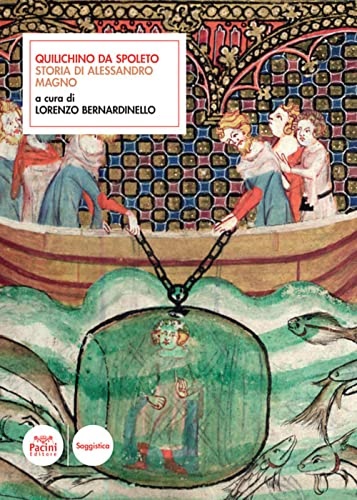
A cura di Lorenzo Bernardiniello. Pisa, Pacini Editore 2021, cm.15x21, pp.326, brossura con copertina figurata a colori. Collana Saggistica. Scrittori Latini dell'Europa Medievale,15. Nel Medioevo il personaggio di Alessandro Magno suscitò un tale interesse che su di lui si scrissero romanzi in latino e in volgare, poemi, cronache, commenti biblici e sermoni. Tra queste opere spicca l’Historia Alexandri Magni o Alexandreis di Quilichino da Spoleto che, per primo, adattò ai distici elegiaci la narrazione di una delle tante ramificazioni del celeberrimo Romanzo di Alessandro dello Pseudo-Callistene, in cui erano riunite tutte le leggende fiorite su Alessandro. L’eroe macedone, nell’avvincente racconto di Quilichino, percorre ogni regione in una sorta di odissea terrestre, incrocia popoli mostruosi e linguaggi ignoti, per sete di conoscenza esplora l’abisso marino e vola in cielo su un carro trainato da quattro grifoni: uno degli episodi più famosi e tra i più rappresentati, solitamente simbolo di colpevole orgoglio. Il testo latino, accompagnato a fronte dalla prima traduzione in italiano, nonché la prima in una lingua moderna, si giova di un puntuale commento e di una introduzione che ricostruisce la biografia dell’autore, analizza il sostrato ideologico cui rimanda la rappresentazione di Alessandro, esamina il rapporto con la fonte impiegata, indaga le ragioni della notevole diffusione manoscritta di cui godette il poema e infine offre una sintetica valutazione delle peculiarità stilistiche.

EAN: 9788869959387
Nuovo
EUR 20.00
-20%
EUR 16.00
Available
In questa edizione curata da Ennio Sandal, le cinquantuno pagine di testo mancanti all'esemplare queriniano sono state restituite mutuandole dalla copia della Biblioteca Trivulziana di Milano (Inc. Petr.1 ). Edizione anastatica dell'incunabolo queriniano G.V.15 (Venezia, Vindelino da Spora,1470). Brescia, Grafo 1995, cm.20x28, pp.XVIII,168 carte numerate solo in recto. il volume riproduce anche tutte le illustrazioni a colori e le note manoscritte a margine dell'edizione originale. legatura editoriale titoli e fregi in oro ai piatti e al dorso. In appendice un contributo di Ennio Sandal e Pietro Gibellini, sull'incunabolo queriniano. Edizione su carta vergata. CON COFANETTO A COLORI.

EAN: 9788873852889
Nuovo
EUR 170.43
-35%
EUR 110.00
Last copy